
Most agency owners focus the bulk of their efforts on top-of-the-funnel activities: more leads, more deals, more wins. But long-term growth doesn’t come from the number of clients you sign—it comes from how long they stay, how much they spend, and how much value you create for each other along the way.
That’s Client Lifetime Value (LTV), and it’s one of the most important metrics that agencies should be paying closer attention to.
We surveyed 165 digital agency leaders across the U.S. and Canada to uncover the real levers behind maximizing LTV, and the findings are clear: the most successful agencies build systems that lengthen client tenure, increase average billings, and manage service costs.
What’s LTV, and why does it matter?
Client Lifetime Value is simple to define: it’s the total revenue you earn from a client over the course of the relationship, minus the cost of acquiring and servicing them. Agencies with high LTV grow faster, having built systems and trust that encourages good clients to stay longer and allocate more budget to the agency.
But LTV is only part of the growth equation. It’s critical to evaluate this in terms of the cost to acquire customers in the first place, known as the customer acquisition cost (CAC). In the full report, we indicate that a “healthy” agency should strive for an LTV:CAC of 3:1.
The main levers for improving this ratio are increasing average client tenure, increasing account revenue, or lowering the cost to acquire new clients. Given how heavily CAC depends on an agency’s individual Ideal Client Profile (ICP), we focused our survey on the other two growth levers, tenure and revenue.
Improving tenure

While the average retainer tenure fell within the 13-24 month range, 42% of agency leaders in our survey reported average retainer tenures of more than 2 years.
Improving client experience is one of the most powerful ways to increase LTV. Long-term relationships often start with thoughtful and smooth onboarding, grow through clear and consistent communication, and are sustained by proactive account management and relationship building. When you strengthen the customer journey, you strengthen client tenure, directly improving LTV.
Improving revenue
Improving how much revenue each account generates begins with strong positioning. Agencies that serve niche markets, or position themselves as premium specialists, can often command significantly higher fees. Additionally, targeting ideal-fit clients is strongly associated with higher client value.
Agencies with a clearly defined ICP report dramatically larger engagements than those without one. On average, their monthly median retainers land around $7,500, more than double the $3,000 median for agencies without a formal ICP.
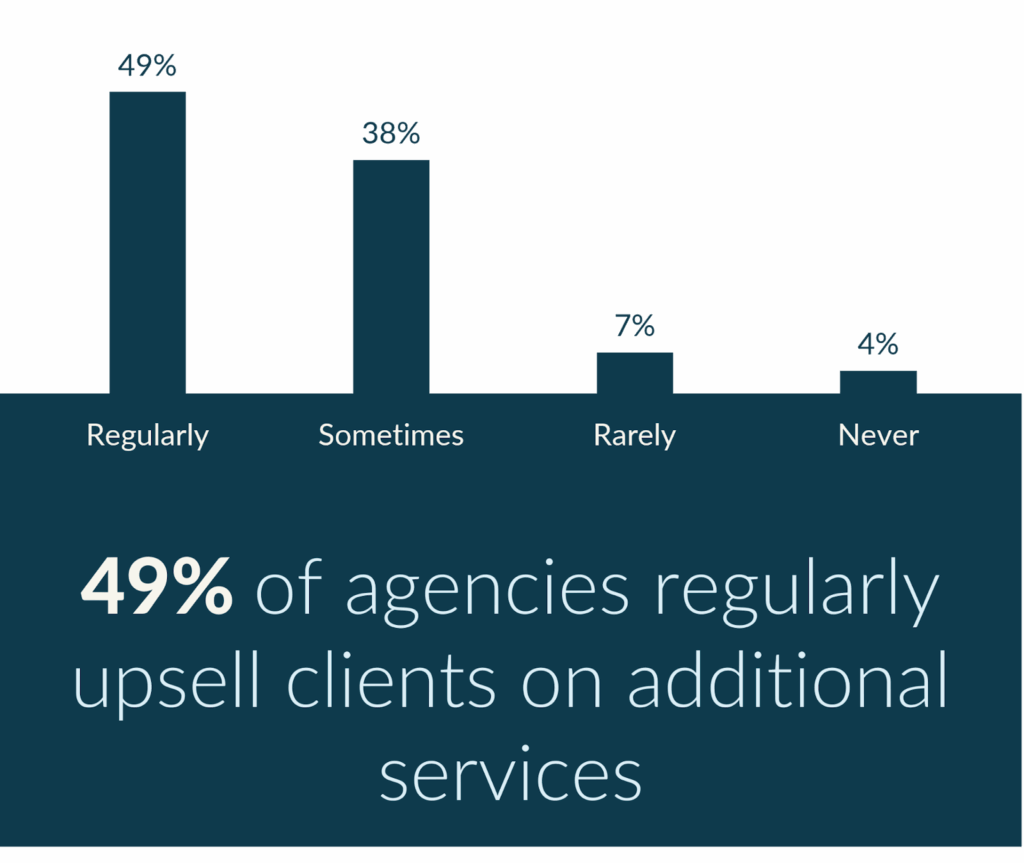
After positioning, the next most impactful way to influence account revenue is by growing existing accounts. Increasing what a client buys, either by moving them into a larger engagement (upsell) or into adjacent services (cross-sell), is another proven way to raise LTV. Of the agency leaders we surveyed, 49% reported upselling clients multiple times per year, and another 38% said they do so occasionally.
For example, adding domains is a small but effective way to keep clients returning year after year. They’re sticky, and many clients will buy a domain before launching their business and stay with their provider for years, Plus, domains renew annually, which is an organic opportunity to reconnect with dormant clients.
OpenSRS Storefront is designed for digital agencies that want to capture long-term value without the overhead. It makes selling and managing domains simple, seamless, and fully white-labeled, so you can offer more to your clients, strengthen retention, and grow recurring revenue without needing to rethink how you do business.
Best practices for maximizing LTV
Our research uncovered 12 areas that have the most significant impact on LTV and CAC:
- Positioning, pricing, and packaging
- Specific ICPs and mapping Buying Committees
- Prioritizing quality acquisition channels
- Optimizing pricing model mixes
- Optimizing engagement size and structure
- Account management practices
- A seamless onboarding experience
- Ensuring and communicating quality service
- Upselling and cross-selling
- Tiering clients based on LTV potential
- Creating and activating evangelists
- Using LTV to guide strategic decisions
Each of these plays a distinct role in shaping an agency’s LTV and CAC, and we cover each in detail in our full report.
LTV as a strategic filter
Successful agencies use LTV to guide their decisions. It’s one of the clearest indicators of whether their positioning, pricing, onboarding, and delivery are working the way they should. By optimizing for value-per-client and refining the levers that drive it, they make smarter decisions, and when those unit economics are right, growth flows naturally.
Get the full report that includes:
- Insights from 165 agency leaders
- Financial models that explore the impact of tenure and pricing on LTV
- ROI examples for retention tactics like domain management
- A deep dive into the 12 key areas agency leaders can use to maximize LTV